
These Regulations comply with the Art Promotion Act (「미술진흥법」) and related laws. Their purpose is to set out the procedures and standards for authenticity appraisal, fair market value appraisal (valuation), and the issuance of certificates for works exhibited and sold at events organized by the Asian Society of Calligraphic Arts (hereinafter the "Society"), thereby securing legal credibility, providing transparency to the art market, protecting the rights and interests of buyers, and leading the establishment of a correct valuation of Korean calligraphy.
06 / 09
In forceRegulations on Artwork Appraisal and Issuance of Certificates of Authenticity
작품 감정 및 보증서 발행 규정
This translation is for reference only. The Korean original prevails in case of any discrepancy.
Chapter 1 General Provisions
Article 2 Scope of Application
These Regulations apply to calligraphy works traded at all exhibitions and sales events planned, organized, or sponsored by the Society.
Chapter 2 Appraisal Committee
Article 3 Composition of the Committee
To ensure the fair appraisal of works, the Society establishes an "Appraisal Committee" (hereinafter the "Committee").
The Committee consists of approximately five members, including connoisseurship appraisers well versed in calligraphic aesthetics and scripts, and scientific appraisers who are experts in conservation science and data analysis.
To maintain the expertise and fairness of appraisal, the Society shall clarify the qualification requirements for appraisal members and shall mandatorily conduct regular advanced training and refresher training.
Appraisal members must complete the expert appraiser training course organized by the Society and renew their qualifications.
Chapter 3 Appraisal Standards and Procedures
Article 4 Principles of Appraisal
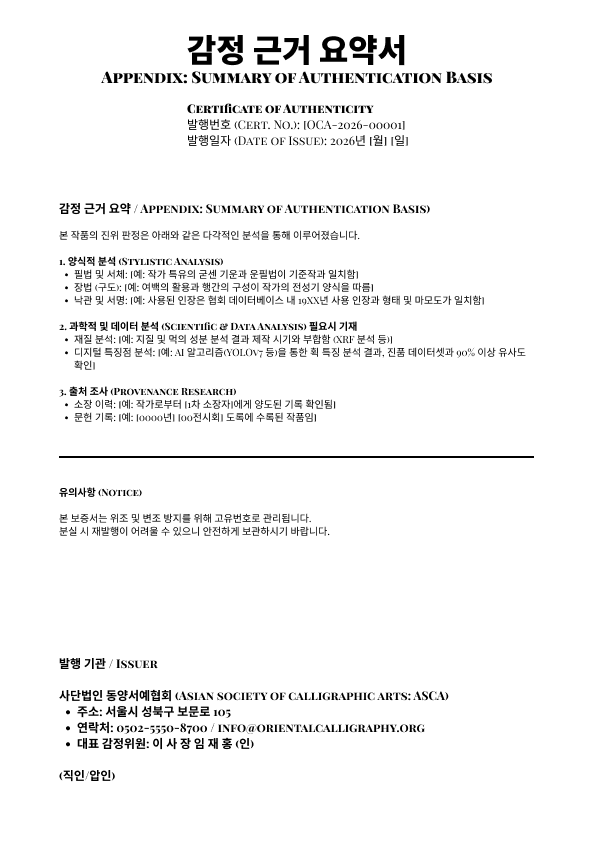
Appraisal shall, as a principle, follow a "multifaceted approach" that combines traditional connoisseurship, scientific analysis, and provenance research.
Article 5 Methods of Appraisal
The Committee shall determine authenticity by the following methods.
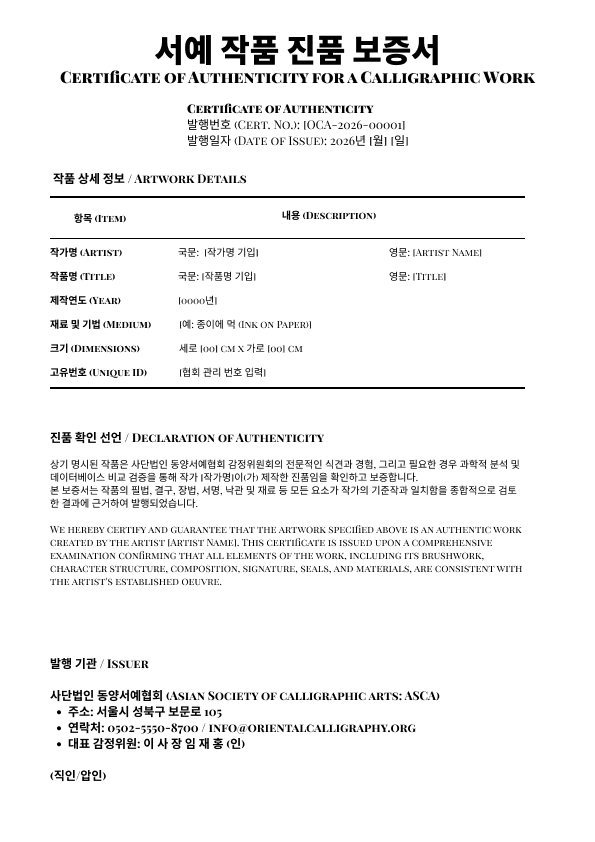
Stylistic Analysis: Compares and analyzes the artist's characteristic brushwork (用筆), structure, layout, seals (落款), and signatures against reference works.
Scientific Analysis: Where necessary, carries out compositional analysis of paper, ink, and seal paste (인주) (XRF, etc.) and dating tests to verify whether the materials are consistent with the period.
AI-based Analysis: Fine patterns and stroke characteristics that are difficult to identify with the naked eye may be supplementarily verified using AI algorithms.
Provenance Research: Traces exhibition catalogs, literature records, ownership history, etc., to confirm the movement history of the work.
Chapter 4 Issuance and Management of Certificates
Article 6 Required Contents of Certificate
A Certificate of Authenticity issued for a work determined to be genuine must necessarily include the following.
Artist's name, title of the work, and year of creation
Materials and technique, and size of the work (height × width)
High-resolution images of the whole work and of its details
Declaration of Authenticity and the content of the guarantee
Information on the issuing organization, date of issue, and the signature and official seal of the representative appraiser
Appraised market value (Valuation Price) and the reference date of the valuation (only where the client has requested a market value appraisal)
Article 7 Unique Number and Prevention of Forgery
All certificates shall be managed under a unique identification number (Unique ID) assigned by the Society to prevent alteration and forgery, and shall be permanently retained in the Society's database.
Certificate paper shall be special paper with a watermark or anti-copy pattern, and the Society's embossed seal (철인) shall be affixed over the image of the work to prevent physical alteration and forgery.
Article 8 Consent to Database Construction and Use
High-resolution images of works and related appraisal data of works exhibited or donated to the Society and subjected to the appraisal procedure may be permanently used as non-commercial research data for the Society's "advancement of the AI authenticity appraisal algorithm" and "construction of a digital archive."
The exhibitor or donor of a work shall be deemed to have explicitly consented to the database construction and use under paragraph 1, and may not raise any objection.
The Society shall manage the data collected under paragraph 1 in a form that does not allow the identification of the artist or owner, and shall not disclose or use it externally for commercial purposes.
Article 9 Reissuance
Certificates are, in principle, not reissued. However, where a certificate has been damaged by unavoidable causes such as natural disasters, the owner may, upon submitting evidence such as fragments of the original and after deliberation by the Committee, have it reissued one time only.
Handling in case of loss: In case of loss, it is reconfirmed that reissuance is in principle not possible. Where reissuance is exceptionally necessary, it shall be stipulated that reissuance may be made only through stricter evidence, such as the owner's written statement regarding the circumstances of the loss and a police report confirmation, and through public notice procedures. (A prescribed reissuance fee may also be set.)
Article 10 Scope of Guarantee and Exemption from Liability
Clear limitation of liability: The effect of the certificate is clearly limited to "the authenticity at the time of issuance."
Explicit exemption matters: The guarantee shall lapse, or the Society may be exempted from liability, upon the occurrence of the following events.
Where the certificate is transferred without notifying the Society
Where the work has been damaged or altered
Where the original certificate is not presented
Where the result of an appraisal by a third-party institution differs, through the Society's re-review procedure, etc.
Addenda <No. 1, 2026. 02.13>
Article 1 Effective Date
These Regulations take effect from the date of promulgation.

Questions about a regulation?
The secretariat answers questions on how an article is read or applied.